

“I haven’t been everywhere, but it’s on my list” is one of the quotes which really represent me. As a passionate traveler I have a long list of places I would like to visit, but only some of these places are on my bucket list.
I think that we all have a list of places we would like to see at least once in a lifetime. Petra was one of those places I have always wanted to visit and fortunately, my dream came true at the end of last year. I’m so happy that I’ve managed to visit this amazing place and I must confess that it really deserves to be among the New Seven Wonders of the World.
Petra is considered the main tourist attraction in Jordan and for good reason. A blend between history, architecture and natural landscapes, perfectly describe the ancient city of Petra. Hidden from the eyes of the world behind high stone walls, Petra displays its beauty in a spectacular way. From the impressive buildings built in stone to the imposing religious edifices and tombs, Petra is simply magical.

The story of this place started in the sixth century BC, when the Nabataeans, an Arabic tribe, settled in this area and began the construction of the ancient city. It is said that the Nabataeans were ancient people mentioned in the Bible, who came from the northern part of the current Saudi Arabia and from the southern part of Jordan. At that time Petra was going through a prosperous period thanks to the spice, silk and slaves trade. Merchants and travelers of all nations were constantly passing through Petra and at a certain time the ancient city became a trade knot.
The glorious Petra lost its independence in 106 AC, when it was conquered by the Roman Empire. As a Roman province, Petra suffered major transformations. The commercial roads were moved to other ancient cities, in the east part of the country and a lot of Roman edifices were built on its territory. After the transition to Christianity, Petra became an important Episcopal Office. The glorious days of Petra ended in the sixth century AC, when the city was hit by a powerful earthquake. During this earthquake, almost all the Roman constructions were destroyed and only the ancient Nabataean ones remained almost intact.
The city was abandoned for more than 1000 years and during this period it was used only by the Bedouins. The ancient city of Petra was rediscovered in 1812 by John Lewis Burkhardt. This was the moment when the difficult process of restoration started and the long-gone beauty of Petra was brought back to life.
Nowadays, Petra is a large complex which stretches along the foot of Mount Hor and covers the eastern side of the Wadi Araba Valley. Taking into account the size of the complex, you should spend at least two days there in case you want to visit the entire place. The best way to enjoy the beauty of this place to the fullest is to visit the complex on your own or using the services of a local guide.
The entrance to this archeological complex doesn’t reveal too much from its extraordinary beauty. A lot of locals dressed in Bedouins will welcome you at the entrance. They will invite you to take a horse ride in order to get to the center of the city in a faster way. My advice is to walk even though it takes a great effort, because this way you will have the chance to admire the entire place. In addition, the locals will only take you a few hundred meters, until the entrance to the Strait Siq and from there you will have to walk more than one kilometer to get to the Treasury. I chose to walk and I don’t regret it at all.

When I look back and think about this experience, I must say that it was worth every step. I still remember the narrow strait which became narrower with every step I took. Surrounded by high orange and pink cliffs on all sides, I had the feeling that I was in a maze. From place to place a tree was embellishing the area with its splash of color. I was stunned by this scenery, but the climax was the moment when I saw the silhouette of Al Khazneh or the Treasury.

According to the legend the Bedouins believed that there was a treasure hidden in this temple but despite searching for it, the treasure has never been found. It is also said that this place used to shelter the tomb of King Aretas III. The Treasury gained its notoriety after being used as a setting for Indiana Jones and the Last Crusade, two well-known movies.
This gorgeous 40-meter high stone monument is the most famous tourist attraction in the entire complex. I must confess that I couldn’t take my eyes off this amazing place. This small depression surrounded by high cliffs was full of tourists who were eager to admire the gorgeous Treasury. In addition, the camels, the locals and the souvenir shops made this place really hard to bear.

Even though I was mesmerized by the beauty of the Treasury, I wanted to get rid of all that fuss that was going on around me. This is why my friends and I decided to accept the services of two local guides who asked us if we wanted to admire the most beautiful views over the entire area. We spent the rest of the day exploring the surrounding cliffs and discovering beautiful panoramas. This turned out to be an inspired choice, because the experience was great. I recommend this type of experience only if you accept the help of local guides because the road is difficult and it might be dangerous.
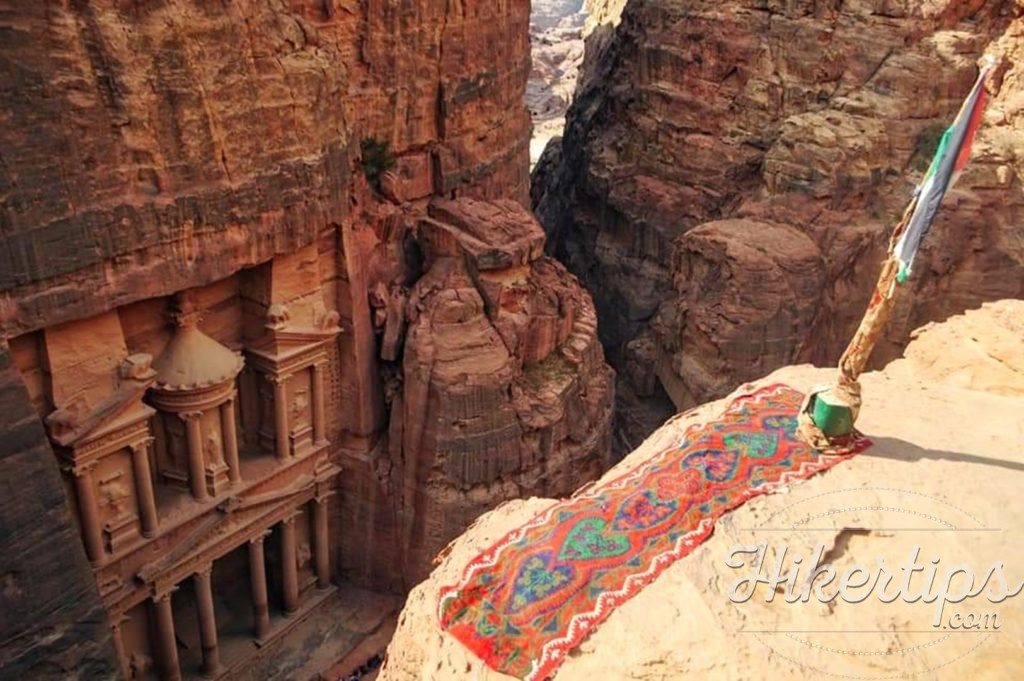
First of all, we climbed the cliffs situated to the right of the monument in order to admire the Treasury from above. We admired this place for almost an hour and then we went down again. Next, we climbed the cliffs situated to the left of the monument. I must confess that the road was quite difficult and the fact that we hired local guides helped us a lot. After a difficult climb we arrived at a place from where the Treasury could be admired in all its splendor. I think we took hundreds of pictures there because the view was absolutely gorgeous.


 The adventure was not over yet and we decided to continue exploring the cliffs until we got to the famous aisle. The High Place of Sacrifice is actually a sanctuary which was used as a place of sacrifice to worship the gods. Situated at an altitude of 170 meters above the city of Petra, this place offers gorgeous panoramic views over the entire area. The effort of getting there is great, but the good news is that you can rest for a few minutes at the top of the cliffs. This is a place where tourists can stop to take a short rest and even enjoy a drink. You can admire the views from there, but my advice is to take a few more steps.
The feeling I had while I was at the top of the high cliffs was absolutely amazing. After admiring those views for hours, we chose another path to go back and this was a perfect opportunity to admire other great panoramic views. The way we chose to return was actually the official road to the aisle. I only realized how fast time passed, when I saw the sun setting. On our way down we stopped on a large plateau from where we could see an amphitheater and a lot of tombs built in stone.
 The day was not over yet and we also decided to see Petra by night. The experience of seeing Petra lit by hundreds of candles was magical. These candles light up the way to the Treasury. The place in front of the Treasury seemed to be cut out of a fairy tale because it was full of lit candles. We sat down somewhere among these candles with a cup of tea in our hands and we started listening to the local who was playing the rabab. It was a real pleasure to listen to the sounds made by the oldest musical instrument in the world. Shortly after this, another local started telling us the story of the ancient city of Petra, while the building was beautifully lit in different shades of colors.
 Overall, Petra by night is quite an experience. In case you want to add it to your trip itinerary, you should take into account that Petra by night is organized twice a week, on Wednesday and Thursday, starting at 20.30. It’s important to buy your tickets in advance at the entrance to the complex and be there around 7 o’clock in the evening.
We continued exploring the complex the following day. We admired again the scenery offered by the gorge and the beautiful Treasury. It was the second time I saw this gorgeous monument and it still impressed me a lot. After admiring the Treasury for a few minutes, we visited the amphitheater and explored the mountain which sheltered many temples and hundreds of tombs. With a seating capacity of over 8500 people, the amphitheater was originally built in the Greek style and it was rebuilt by the Romans after it became a Roman province. The mountain which shelters the tombs and the temples is actually a high rock with a lot of facades built in stone. You can go up the stairs in case you want to have a closer look at the facades of the tombs and temples. Some of these tombs can still be visited.

 After exploring the street and admiring the impressive facades, we continued walking through the depression. The most difficult part, but also the most beautiful one started when we began climbing the cliffs to get to Ad-Deir or the Monastery. You have to climb around 850 stairs and follow small narrow paths, but you cannot leave Petra without discovering the second most famous monument in the complex. The curved road and the high cliffs created a breathtaking scenery. The only one aspect I didn’t like was related to the souvenir shops which were situated on both sides of the road. The good news is that there you could find souvenirs at really good prices. You can also take a donkey ride to reach the Monastery, but it would be a pity not to walk because the road is very beautiful. In addition, you could spare this animal of making a great effort.

 We reached the top of the mountain in the afternoon when the Monastery was caressed by the sun. Despite having different architectural motifs, the Monastery and the Treasury have a similar appearance. Like the Treasury, the Monastery also used to shelter a tomb. It was King Obodas’s tomb. The main difference between them is probably the fact that the Treasury is situated at the foot of the cliffs while the Monastery is situated at the top of them. A few steps away, there is a place from where you can admire the Monastery and the surrounding area in all their splendor.
 Unfortunately, after spending a few hours there, we had to go back. I still remember how hard I was trying to memorize every detail of this trip. Petra was indeed a great experience and it definitely deserves to be on every person’s bucket list.
As I have already said, you should spend at least two days in Petra, in case you want to have a complete experience there. This is why I recommend the Jordan Pass, a sightseeing package which includes your tourist entry visa, two entrances to Petra and also the entrances to Wadi Rum Desert, Jerash and many other tourist attractions. The Jordan Pass gives you the chance to save time and money because it costs only 55 dinars per person. Petra by night is not included in this package and for this experience you have to pay 18 dinars extra. When it comes to accommodation, Wadi Musa, the nearest town is the best place to stay during your visit to Petra.
All things considered, Petra is undoubtedly the main symbol of Jordan and an outstanding tourist attraction.


